> For the complete documentation index, see [llms.txt](https://docs.violetlabs.com/llms.txt). Markdown versions of documentation pages are available by appending `.md` to page URLs; this page is available as [Markdown](https://docs.violetlabs.com/features/dashboards.md).
# Dashboards
Stay informed on the data you care about with Violet **Dashboards**.
The dashboard provides a quick glance of what's happening across your organization, including high level metrics, recent changes in data and a collection of the tasks, issues or tests assigned to you.
High-level metrics track key indicators of your data in Violet:
* **Connected Apps** The number of integrations that have been connected and configured
* **Tracked Entities** The amount of data (known in Violet as "entities") that is being ingested and tracked.
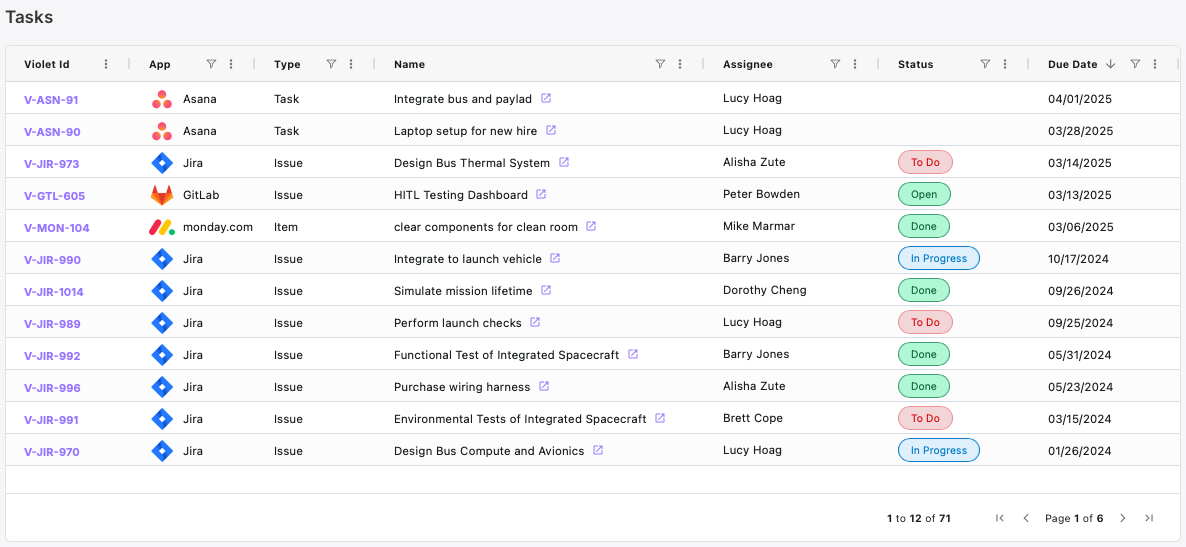
The **Tasks** table aggregates entities like tickets, issues, requirements, PO approvals and tests that are assigned to you. By default, this table shows the app, entity type, name, status and due date for each entity that belongs to you.
You can filter and sort the Tasks table to configure the view that is most suitable for you.
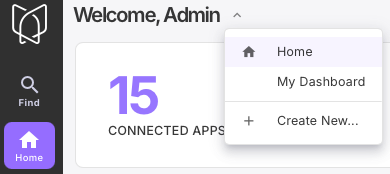
To create a new dashboard, click the arrow directly next to your name in the top-left corner of the screen. Custom dashboards can be made public or private.
Any dashboards that are viewable by you will be accessible here under **Home.**
---
# Agent Instructions
This documentation is published with GitBook. GitBook is the documentation platform designed so that both humans and AI agents can read, navigate, and reason over technical content effectively. Learn more at gitbook.com.
## Querying This Documentation
If you need additional information that is not directly available in this page, you can query the documentation by asking a question.
Perform an HTTP GET request on the following URL with the `ask` and `goal` query parameters:
```
GET https://docs.violetlabs.com/features/dashboards.md?ask=&goal=
```
`ask` is the immediate question: it should be specific, self-contained, and written in natural language.
`goal` is what the user is ultimately trying to achieve, the reason they need the answer. Sharing it helps GitBook give you a better, more relevant answer. A goal is most helpful when it describes the outcome the user wants rather than restating the question. For example, with `ask=how do I create an API token`, a goal like `automate deployments from our CI pipeline` lets GitBook tailor the answer to that use case.
The response will contain a direct answer to the question and relevant excerpts and sources from the documentation.
Use this mechanism when the answer is not explicitly present in the current page, you need clarification or additional context, or you want to retrieve related documentation sections.