> For the complete documentation index, see [llms.txt](https://docs.violetlabs.com/llms.txt). Markdown versions of documentation pages are available by appending `.md` to page URLs; this page is available as [Markdown](https://docs.violetlabs.com/features/programs.md).
# Programs
Violet **Programs** contain data like Requirements, Schedules and Systems. They can be used to enable granular permissions to Requirements and other features. Programs can be [shared](/features/programs/shared-programs.md) with external collaborators or [cloned](/features/programs/clone-programs.md) to accelerate requirements development.
## Create a program
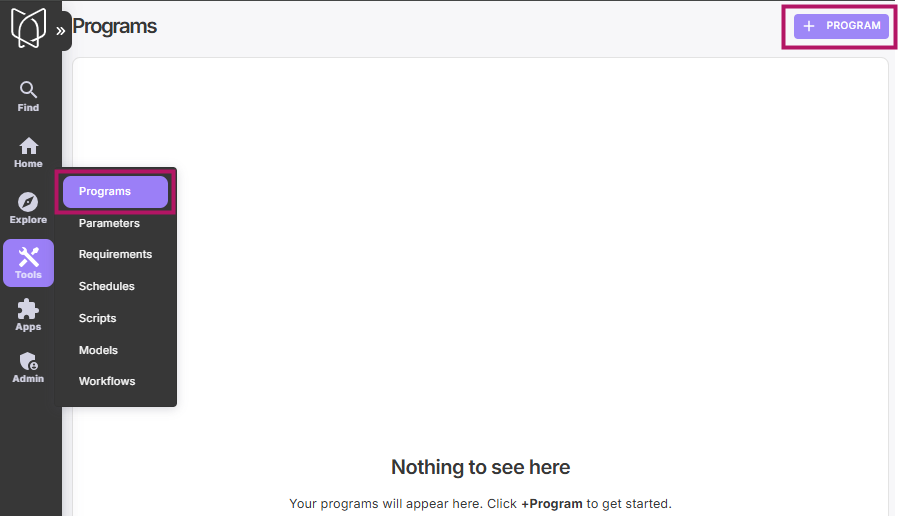
Any user can create a program; begin by navigating to **Tools** → **Programs** and click **+Program**:
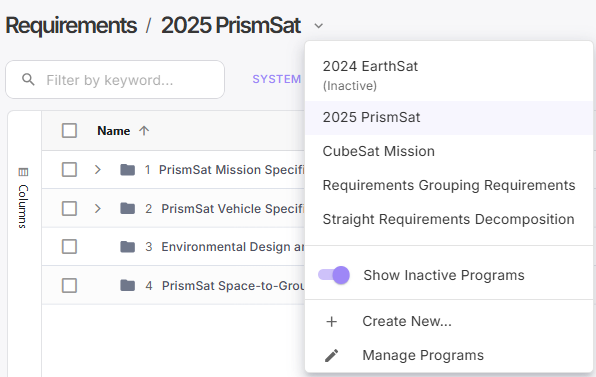
Alternatively, new programs can be created directly from the Violet Requirements page. In the dropdown menu at the top of the screen, select **Create New:**
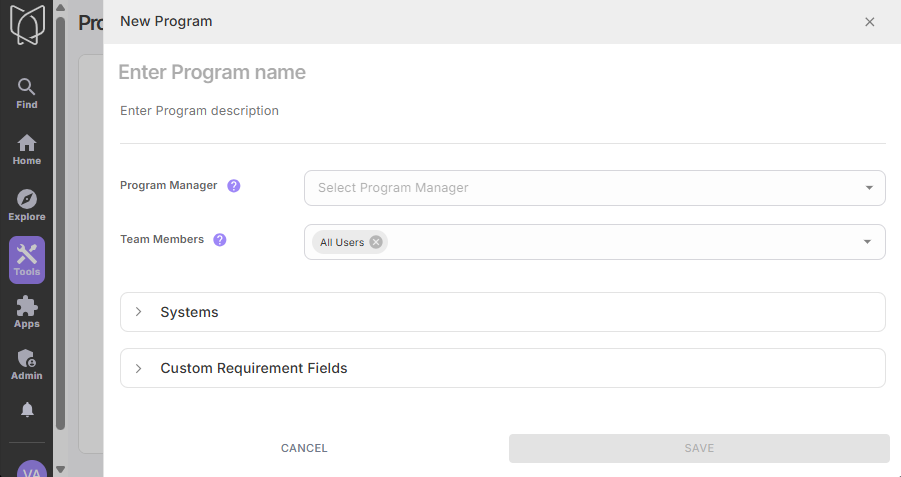
In the **New Program** window, enter a program Name and Description (optional).
## Assign team members
Assign one or more users as **Program Managers**, which grants them administrator-level permissions to manage the program, as well as edit access to any requirements within the program.
Next, assign users or groups as **Team Members.** Team members have **read** access to the program. They will be able to view all details about the program as well as all requirements within the program. The "All Users" group consists of all users internal to your organization's Violet instance.
See [Invite your team](/resources/administrative/invite-your-team.md) for guidance on setting up user groups.
### Adding guest users
We want to make it easy to collaborate with external users while maintaining control of your data.
To invite external or "guest" users, we recommend creating a dedicated user group for any external Violet users who require read-access to the program, then add that external group as a team member for the appropriate program(s). These guest users can review Violet requirements and add comments, but can't see other Violet platform data.
## Create System Elements, Custom Requirement and Verification Fields
Finally, you can define [Systems](/features/requirements/systems.md) and [Custom fields](/features/requirements/custom-fields.md) for the requirements and verifications in a program.
Assigning users or groups to System elements grants them **edit** access to the requirements within that system; these users are the designated requirement **owners**.
Systems can also be used to filter, sort, visualize and track progress of Violet Requirements - read more [here](/features/requirements/systems.md).
## Hide Inactive Programs
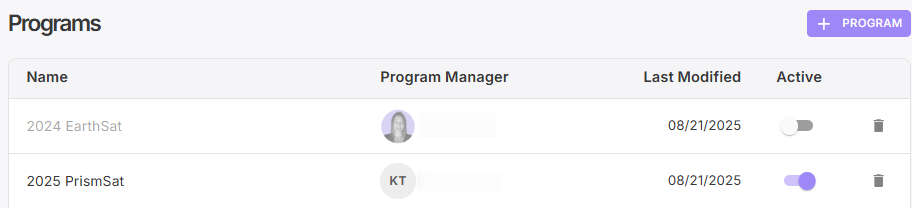
Toggle the **Active** button to mark a program as **inactive.** This feature hides the program from the requirements drop down list.
If you still wish to view requirements from an inactive program, use the **Show Inactive Programs** toggle in the requirements pulldown menu.
---
# Agent Instructions
This documentation is published with GitBook. GitBook is the documentation platform designed so that both humans and AI agents can read, navigate, and reason over technical content effectively. Learn more at gitbook.com.
## Querying This Documentation
If you need additional information that is not directly available in this page, you can query the documentation by asking a question.
Perform an HTTP GET request on the following URL with the `ask` and `goal` query parameters:
```
GET https://docs.violetlabs.com/features/programs.md?ask=&goal=
```
`ask` is the immediate question: it should be specific, self-contained, and written in natural language.
`goal` is what the user is ultimately trying to achieve, the reason they need the answer. Sharing it helps GitBook give you a better, more relevant answer. A goal is most helpful when it describes the outcome the user wants rather than restating the question. For example, with `ask=how do I create an API token`, a goal like `automate deployments from our CI pipeline` lets GitBook tailor the answer to that use case.
The response will contain a direct answer to the question and relevant excerpts and sources from the documentation.
Use this mechanism when the answer is not explicitly present in the current page, you need clarification or additional context, or you want to retrieve related documentation sections.